Wednesday, August 21, 2013

Evolution For Dummies - Part 3

Welcome to Evolution For Dummies - a multiple part post that will hopefully dispel a few misunderstandings about the sometimes thorny topic of Evolution. 

In Part 1 and Part 2, I introduced the idea of family trees and inheritance. I talked about how these trees can be simplified and expanded to demonstrate the interrelationships between the members of enormous families. I used the example of my friend Max, to illustrate the possibility that a single individual could have thousands of  contemporary relatives, just by looking at 5 generations - maybe 150 years - and how some of those relatives may look entirely different, speak different languages and have very strange customs (such as bog-snorkelling)! This, if you recall, was even in a "reproductively inefficient" family (only 2 offspring per generation and only 2 siblings for everyone who married into the family). At this stage, I should mention that I didn't include the concept of "removed cousins" either - Max's 1st cousins once removed (the children of his first cousins), for example. Family trees really can get complicated!

Just as a reminder, here is the family tree I first introduced, showing the relationships between my friend, Max, his sibling, and his 1st, 2nd, 3rd and 4th cousins. The various forks in the tree represent relatives such as mother, grandmothers, aunts, great aunts etc:


At this point it may be worth pointing out what may quite possibly have been obvious all along - that in these family trees, time is represented along the horizontal plane. As you move right to left, you are moving from my friend and his cousins, through the generations, backwards in time.

In this tree we were able to show that the most recent common ancestor of Max and his 4th cousins is "great-great-great grandmother" (which is exactly what the term "4th cousin" defines - someone who shares a great-great-great grandmother, but not a great-great grandmother nor anyone else higher on the family tree). We also determined that Max's 3rd cousins are more closely related to him than they are to his 4th cousins, because Max's 3rd cousins share a more recent common ancestor with Max than they do with his 4th cousins.

And this is the more simplified family tree I used to show the relationships between Max and his 5th cousins, but now leaving out a lot of detail about aunts (the mothers of 1st cousins), great aunts (mothers of 2nd cousins) and lot's of other distant family members.


I explained that we must look at the common ancestors of individuals, or individual groups, on the tree to infer relationships, but to NOT count forks - or nodes - because many of the forks may be missing. For example, a fork representing Max's parents is missing, as are the forks that would represent parents, grandparents and great-grandparents of his 3rd cousins.

I then used the "primate" family to show how, if you trace a family tree back far enough in time - millions of years - you can find the common ancestors of all primates and, more specifically, the common ancestor of humans and all other primates. I used the tree below to show the relationships between Max (a human being - Homo sapiens) and several other members of the primate family (remember that Homo sapiens is actually a member of the primate family): 


And, before we move on, I'll reiterate a very important point about these relationships. Using the same rules we applied to Max's more recent family, where we saw that his 3rd cousins are more closely related to him than they are to his 4th cousins (they share a more recent common ancestor), we can see that chimpanzees are more closely related to humans than they are to gorillas, because the common ancestor of gorillas and chimpanzees lived much further back in time than did the common ancestor of humans and chimpanzees. 

Aawwlrighty then.....so this is all about common ancestry. And, actually, we are already getting used to the next concept of evolution - that of phylogeny.

Phylogeny can be defined as "the evolutionary development and history of a species or higher taxonomic grouping of organisms". To put that much more simply, it is the study of family trees - which is what we've already been doing. Aren't we awesome?!

So that we can delve a little deeper into the interrelationships between larger groups of animals, I'm going to introduce a slightly different graphical representation of these relationships. When talking about my friend’s family, I used these handy little forks and lines depicting that transfer of genes between parents and offspring:


Where you see the labels "parent" or "grandparent" or "aunts/uncles", you will see a fork – what we call a “node” in the family tree. These are family members who produced offspring. At the tip of the tree are the offspring of the same generation, or contemporaries - my friend, his sibling and his cousins. And the lines are those lines of inheritance or gene transfer I talked about right at the beginning of Evolution For Dummies - Part 1. 

In the next few examples, I’ll be showing you similar family trees, but now the fork-like diagrams are replaced with much more square diagrams. But the principle is the same. The nodes are now where two lines meet perpendicular to each other to form a T-shape. So, for example, here is my friend’s simple family tree - as above - shown over two generations. The red arrows show where the nodes are. 


And here is the primate family - similar to how I showed it before - but now using this more square phylogenetic tree:


The principle is the same. Looking right to left along the horizontal plane takes you backwards in time, and where the lines meet perpendicular to each other to form a T-shape is a node that represents a common ancestor. So you can see that the two types (species) of chimpanzee (Pan paniscus and Pan troglodytes) share a more recent common ancestor with each other than they do with any other primate. You can also see that chimpanzees share a more recent common ancestor with humans (Homo sapiens) than they do with gorillas. Remember, also, that the two species Homo erectus and Australopithecus afarensis became extinct and so their lines are shorter to show that they are not contemporary - not "of the same generation".

Now, as promised in Evolution For Dummies Part 1, we can use this sort of chart to depict the common ancestor of bears and humans, dogs and cats and humans and, ultimately the common ancestor of all mammals and humans. In fact, we can trace the common ancestor of all life on Earth with humans. Yes, folks, the Tree Of Life.

This is how we can depict a phylogenetic relationship between humans (shown in red) and all of the mammals (separated into distinct groups):


Now, this tree raises an interesting point. Look at how the relationship between the apes is depicted. Above, I showed you this relationship:


And if I remove the extinct groups for simplicity, and use the same common names used in the larger tree it would look like this:


But in the larger tree, the chimpanzees are at the bottom, and the gorilla and the human are next to each other, whereas in the smaller tree the gorilla is at the bottom and the human and gorilla are separated by the chimpanzees. WTF, man!  Here's how they look next to each other:


Have I made a mistake somewhere?

Well, actually, no! The important thing is that in both of these trees, the relationships between the animals are identical. In both trees, the two species of chimpanzee (Bonobo and Common chimpanzee) share a more recent common ancestor with each other than they do with any other primate. Also, the chimpanzees share a more recent common ancestor with humans than they do with gorillas. And, extending the tree backwards, you will see that gorillas and humans share a more recent common ancestor with each other than either of them share with orangutans, gibbons, old world monkeys and so on backwards in time down the tree. This is what is important - the RELATIONSHIPS between animals. The "tines" of the forks can be rotated, so the position of any animal next to another at the tip of the tree doesn't matter at all. It is simply a matter of preference for whomever is drawing the tree, as long as the relationships don't change. As I said earlier, you have to follow those lines of inheritance backwards in time to find the common ancestors and make inferences about relationships from there.

I want to labor this point a little by using my friend's family tree again. If I rotate the branches at the fork that represents my friend's parents, I can place his sister at the top of the image, where he used to be, like this.

Rotating the branches around the fork of a tree doesn't change the relationships between any family member

Although my friend is now placed more closely to his cousin at the tip of the tree, his relationship to his cousin is unchanged. His cousin is still his cousin and they still share a grandmother.

Similarly, if I rotate the branches at two forks - those that represent my friend's grandmother and great-grandmother, I can bring my friend "closer" to his 3rd cousins at the tip of the tree. Like this:
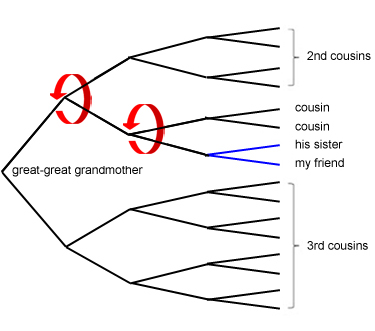
Rotation of branches around two forks - no change in relationships.

Now, although my friend may be within handshaking distance of his 3rd cousins at the top of the tree, his relationships with them are still unchanged. When you trace back the lines of inheritance - the lines of gene transfer - he still shares a great-great-grandmother with his 3rd cousins, and all of the other relationships are completely intact. And this is why you should never try to infer relationships between animals in a phylogenetic tree from their positions at the tips of the branches. It is only by tracing the branches backwards to find the most recent common ancestor that such relationships can be determined.

Phylogenetic trees such as these are derived using various methods and various measurements. These can include things such as genetic similarities or differences, or morphological similarities or differences. We can make the trees as simple - or as complex - as we need, to highlight the relationships about which we might be interested. So for example, approximately half way up the big mammal tree I showed (above), you can see some animals we discussed in Part 1 – the cat and the dog. In this tree, they have been placed in a group of mammals along with the bear, the weasel and the seal. Here is that section of the tree:


As I said, we can make these trees as simple - or as complex - as we need, to highlight the relationships about which we might be interested. The author of the "mammal family tree" above was clearly not interested in the complexities of the relationships between cats, dogs, weasels and seals, because he/she just lumped them all together into a single group. But, perhaps somebody else might be interested in those complex relationships. So let's expand the "Cat dog bear weasel seal" branch to show the relationships between all of these animals:


Here we can see, as I mentioned in Part 1, how the hyena is more closely related to the cat than the dog, but also – maybe surprisingly - how the dogs, the wolves and foxes (canids) are more closely related to the seal and walrus than to the cat!

Going back further in time, we can put together a phylogenetic tree showing the relationship between all vertebrates (animals with a backbone), now including, for example, birds, reptiles, amphibians and fish:

The vertebrates

And the further we go back in time, the more relationships we can infer to more and more species on the planet until we eventually construct an entire tree of life which can even include extinct species – neanderthal man, dinosaurs, the dodo etc:

It's life, Jim, and exactly as we know it!


 And it really is a beautiful thing to behold:

The Great Tree of Life. Click on the image for high resolution (from http://visual.ly/great-tree-life)


Ok. Deep breath. Shake it out. 

What I’ve told you about so far in this series on evolution is that you can use family trees to follow lines of inheritance - or lines of gene transfer - from offspring, back through time to the common ancestors that gave rise to groups of relatives, or groups of animals. I've told you that populations are immensely important. That they arise quite quickly even in species such as the human, which is not particularly fecund – meaning that the individuals don’t produce large numbers of offspring very quickly. And that it is in populations that the genetic changes occur that provide for diversity in characteristics such as morphology – shape, size, skin color, etc. I’ve also told you how we can construct - and interpret - phylogenetic trees to show the interrelationships between animals and to trace the common ancestors of entire groups of animals. 

In Evolution For Dummies Part 4, I'll try to answer the big question. Why is this important? Why do we care? 

Watch this space!

Tuesday, August 20, 2013

Evolution For Dummies - Part 2

Welcome back to my multi-part series on the Theory of Evolution. In this second part, we will start to expand on the idea of........ 

"Families and Phylogenies" 

In Evolution For Dummies - Part 1, I explained the central concept of common ancestry. I showed that there are no straight lines linking monkeys or apes to human beings, but that humans and apes are both part of an exquisitely complex family tree that stretches back hundreds of thousands of generations and millions of years. I told you that we are not descended from monkeys or apes at all, but in the same way that it would be possible to trace back the family histories of all domesticated dogs to find the common ancestral wolf, it is theoretically possible to trace back any human's ancestry to a point where a common ancestor with apes can be identified. I emphasized that there is no such thing as a half-my friend, half-his cousin-type animal; no such thing as a half-Great Dane, half-Chihuahua-type animal (a Great Chihuadane); no such thing as a half-crocodile, half-duck-type animal (a Crocoduck); and so it should come as no surprise that there is no half-human, half-ape-type animal ("absolutely, positively, no way in heck is this even remotely possible based on evolutionary theory"). Humans and apes simply share a common ancestor, in the same way that the Chihuahua and the Great Dane share a common ancestor.

I'm going to extend the family tree concept a little and talk about family trees as they are used to demonstrate the interrelationships between groups of animals.

Here is a similar family tree to the ones I used previously to illustrate my friend's extended family. But in this one, I have left out much of the detail to show just a few of his extended family members.

A simplified family tree showing 5 generations (note that my friend's parents have been omitted, so the blue lines linking my friend to his cousins represent TWO generations)

I'm going to dwell on this family tree, because it will help to show how to interpret more complicated family trees and relationships. Biologists (Gawd bless 'em!) have a knack of "simplifying" family trees, but because they don't provide a good explanation of that simplification, many people who aren't biologists (and, actually, many people who are biologists) can no longer understand what the tree means! But worry not - I am here to help! 

In the family tree above, we can see that all of my friend's distant family members have now been placed into groups. We know from the previous post that, even in a small family with "low reproductive efficiency" (low fecundity), my friend could easily have more than sixteen 4th cousins. But in this tree, all of these folks are now shown as a group of "his 4th cousins".

What is also important is that I have simplified the tree even further by leaving out lots of the forks, because they tend to make large trees very messy. For example, I've removed my friend's parents (identified below in red), so the blue line linking my friend to his grandmother is actually representative of TWO generations, going from my friend, through his parents, to his grandparents. Similarly, the blue line linking my friend's grandmother to his cousins is also representative of TWO generations, because his cousins' parents are now missing from the tree.

The same simplified family tree showing 5 generations, but now showing how my friend's parents and his cousins' parents had been omitted, so the blue lines linking my friend to his cousins both represent TWO generations.

Now - here's a question: How many generations are represented by the black line linking my friend's great grandmother to his 2nd cousins?

The answer is THREE generations, because in this line, my friend's 2nd cousins' parents AND grandparents have been omitted (shown below):

The same simplified family tree showing 5 generations, but now showing how my friend's 2nd cousins' parents and grandparents had been omitted.

Similarly, the line linking my friend's great-great-great grandmother to his 4th cousins represents FIVE generations. The parents, grandparents, great-grandparents and great-great grandparents have all been left off the tree (shown below). This is done to simplify the tree and to show only the detail that interests us. In this case, what interests us is the relationship between my friend and his 1st, 2nd, 3rd and 4th cousins.

The same simplified family tree showing 5 generations, but now showing how my friend's 4th cousins' parents, grandparents, great grandparents and great-great grandparents had been omitted

So, knowing how this 5 generation family tree has been simplified, we can make some obvious evolution-style observations about the interrelationships of my friend and his extended family. For example, we can see from the blue lines that the most recent common ancestor of my friend and his 1st cousins is "grandmother". And this is perfectly true and factual. Our cousins share a grandmother, but nor a parent with us. We can also see, by tracing the lines back in time (the red arrows in the image below), that the most recent common ancestor of my friend and his 4th cousins is "great-great-great grandmother". 

Tracing the most recent common ancestor of my friend and his 4th cousins

This is also true and factual, because 4th cousins are defined by the fact that they share a great-great-great grandmother, but not a great-great grandmother (nor anyone else higher on the branches of the family tree).

But here is where the simplification of the tree can get a little confusing for many people:

Consider these three questions:

1.    Who is the most recent common ancestor of my friend's 3rd cousins and my friend's 4th cousins? 

2.    And what is the relationship between these groups?

3.    Are my friend's 3rd cousins more closely related to his 4th cousins than they are to him?

Well, given a little thought, most of us would probably be able to work this out, because we are quite used to dealing with families - even if it is only forced upon us at Thanksgiving or Christmas and we may wish that some distant relatives were even more distant (if you catch my drift)! But let's go through the exercise anyway. 

Recall that some of the detail is missing from the family tree, but you will see that the most recent common ancestor of my friend's 3rd cousins and my friend's 4th cousins is "great-great-great grandmother" - we can see that by tracing the lines back, thus:
 
Tracing the most recent common ancestor of my friend's 3rd and 4th cousins

So now let's answer the second question from above: What is the relationship between my friend's 3rd cousins and my friend's 4th cousins? 

Well, if their most recent common ancestor is "great-great-great grandmother", meaning that they share a great-great-great grandmother, but not a great-great grandmother (nor anyone else higher on the branches of the family tree), then their relationship to each other must be 4th cousins.

And, actually, this is absolutely correct. It may be a little confusing, but my friend's relationship to his 1st, 2nd, 3rd and 4th cousins is independent of their relationship to one another. And to labor THAT point (believe me - its important!), here are a series of trees showing those relationships:

All of the folks within the squiggly bracket below are first cousins to each other:

A group of first cousins.

As well as my friend being 2nd cousin to his 2nd cousins (perhaps obvious!), my friend's 1st and 2nd cousins are also 2nd cousins to each other, because they share a great grandmother!


As well as my friend being 3rd cousin to his 3rd cousins (perhaps obvious!), my friend's 1st, and 2nd cousins are also 3rd cousins to his 3rd cousins, because they all share a great-great grandmother!


And finally, to really labor the point, as well as my friend being 4th cousin to his 4th cousins (perhaps obvious!), my friend's 1st, 2nd and 3rd cousins are also 4th cousins to his 4th cousins, because they all share a great-great-great grandmother! 


Where a lot of people make mistakes in reading trees like these is by forgetting that much of the detail has been left out and that the parents, grandparents, great-great grandparents (and so on) are omitted from most of the lines. They are tempted to think that, in the trees above, my friend's 3rd cousins are more closely related to his 4th cousins because there are fewer "forks" depicted on the family tree. They would count three forks going from my friend to his 3rd cousins, but only two forks moving from his 3rd cousins to his 4th cousins, and assume that this means that his 3rd and 4th cousins are therefore more closely related to each other than they are to him. But we have seen that several forks are actually "missing" in this particular family tree, one of them even when we trace the line of inheritance from my friend to his grandmother (his parents have been omitted), and that there are four forks missing along the line that leads from his 4th cousins to his great-great-great grandmother. Therefore, the common mistake NOT to make is to count forks - or nodes - on the family tree, because many of them may have been omitted for "simplicity" (or at least what Biologists consider "simplicity"). We should always look for the most recent common ancestor - the shared fork, or node - and make our assumptions about interrelationships from there. And, as we know from thinking about our own families, cousins cannot be more closely related to us than are our siblings, and - similarly - 4th cousins cannot be more closely related to us than are our 3rd cousins. Just as importantly, our 3rd cousins cannot be more closely related to our 4th cousins than they are to us, because we share a more recent common ancestor (a great-great grandmother) with a 3rd cousin, but our 3rd and 4th cousins only share a great-great-great grandmother, and so you have to go back further in time to find their most recent common ancestor.

Okay - take a deep breath. We are now ready for the next step!

As I promised in Evolution For Dummies - Part 1, we can now move beyond my friend and his relationships to his distant family and look at his relationship with the apes. To do this we use a highly simplified family tree in which we not only omit my friend's parents, but now we omit his cousins and 2nd, 3rd and 4th cousins, great-great-great grandparents and, in fact hundreds of thousands of generations so that finding the most recent common ancestor of my friend and the apes is made a little less confusing. So that the path he chooses in that backwards-in-time journey through the generations is less cluttered, we'll miss out hundreds of thousands of forks along the path that lies between my friend and the most recent common ancestor he shares with the apes. In fact, we are going to simplify the tree even at the tips of the branches and, as we did before - by merging all of my friend's fourth cousins into a single "his 4th cousins" group - we are now going to merge my friend into the entire "human family" and make a single "Homo sapiens" group. What we end up with is something like this:


You'll notice that two of the branches on the tree above are shorter than the others. This is done to represent the fact that these two groups of animals (Homo erectus and Australopethicus afarensis) became extinct at some point in the past. Clearly, these animals are no longer contemporaries, or of the "same generation" as human beings, but it shows that, had these animals survived, they would have been more closely related to humans than are the chimpanzees or gorillas. They would have been akin to "1st and 2nd cousins" of humans, whereas, in this scheme, the chimpanzees are like "3rd cousins" and the gorillas like "4th cousins". We've also simplified all of the branches and missed out many more ape species that could be included if we wanted to show the interrelationships between, say, humans, chimpanzees, gorillas and bonobos (pigmy chimpanzees). The pigmy chimpanzees are more closely related to chimpanzees than they are to any of the other species shown on this tree, and their relationship could be represented like this:


This shows that the chimpanzee shares a much more recent common ancestor with the pygmy chimpanzee than it does with humans. Thinking again of my friend's family tree, the chimpanzees and bonobos are both akin to "3rd cousins" of humans, but they can be thought of as being almost like "siblings" within that group of 3rd cousins - much more closely related to each other than they are to any of the other groups.

We could now add the orangutans, which are more distantly related to humans than are the gorillas, and now let's also introduce a second species of gorilla:


This shows that the two species of orangutan are more closely related to each other (more like "siblings" within a "5th cousin" group), and share a much more recent common ancestor with each other than they do with any other species. And the same applies to the two species of gorilla, who would be "siblings" in a "4th cousin" group.

Note, however, that by applying the same rules we applied to my friend's family tree, we can trace the lines of inheritance back (don't count the forks!) to the most recent common ancestors and see that both species of gorilla and both species of chimpanzee are more closely related to humans than they are to the orangutans! Also, chimpanzees are more closely related to humans than they are to gorillas!

I should emphasize here that, obviously (I hope), chimpanzees are most certainly NOT our 3rd cousins! I've used this term extremely loosely just to continue the theme of family trees and to make the concept of evolutionary relationships a little easier to understand. The chimpanzee has a shorter life-span and slightly shorter gestational period than the human, and has a resulting shorter "generation interval". So if a contemporary, modern chimpanzee wanted to trace back his ancestry to find his common ancestor with humans, he would undoubtedly have to travel through many more generations than would my friend. This generational difference would be represented by "so many times removed", in the same way that my friend's 1st cousins' children would be "once removed" and their children would be "twice removed". Many people have attempted to approximate the "degree of cousinhood" between chimpanzees and humans, but all such attempts should be taken with a grain - or bucket - of salt. Telling a chimpanzee you see at a zoo or on Discovery Channel that he maybe your 230,000th cousin, 10,000 times removed probably won't get you invited to his birthday party.

Now, if we want to add "monkeys" to this family tree, we'd have to go much further back in time. 

First, we should add the many species of gibbon:


 And then we can add a group known as the "Old World Monkeys":

And, finally, let's add the "New World Monkeys":


As we added more species, or groups, of animals to the family tree, you can see that we went further back in time to find the common ancestors we share with these animals. We could keep going, still among the primates, and add the tarsiers:
 
a tarsier

and then the lemurs and bush babies:

"I like to move it, move it...." A lemur

But again, notice that the tarsiers are actually more closely related to the human being than they are to the lemurs and bush babies, because we humans share a more recent common ancestor with tarsiers than we do with the lemurs - and vice versa!

So, we are getting there! I've now shown you how we can build enormous family trees - and then simplify them - to illustrate the interrelationships between the primates. You can see how we share a more recent common ancestor with all the apes (chimpanzees, gorillas and orangutans) than we do with any other primate. But also, in the same way that my friend's 3rd cousins are more closely related to my friend than they are to my friend's 4th cousins, the humans and apes are actually more closely related to each other than any of them are to monkeys, because apes and humans all share a more recent common ancestor than do apes and monkeys.

In Evolution for Dummies Part 3, I will show how we can expand this understanding of the interrelationships between all of humanity and other primates. I'll show how we can trace even bigger family trees back millions and millions and millions of years, beyond the point where we find the common ancestor of apes and humans, and back to the point where we find the common ancestor of bears and humans, dogs and cats and humans and, ultimately the common ancestor of all mammals and humans.

Watch this space!